
The Almoravid Dynasty & The Birth of the Red City
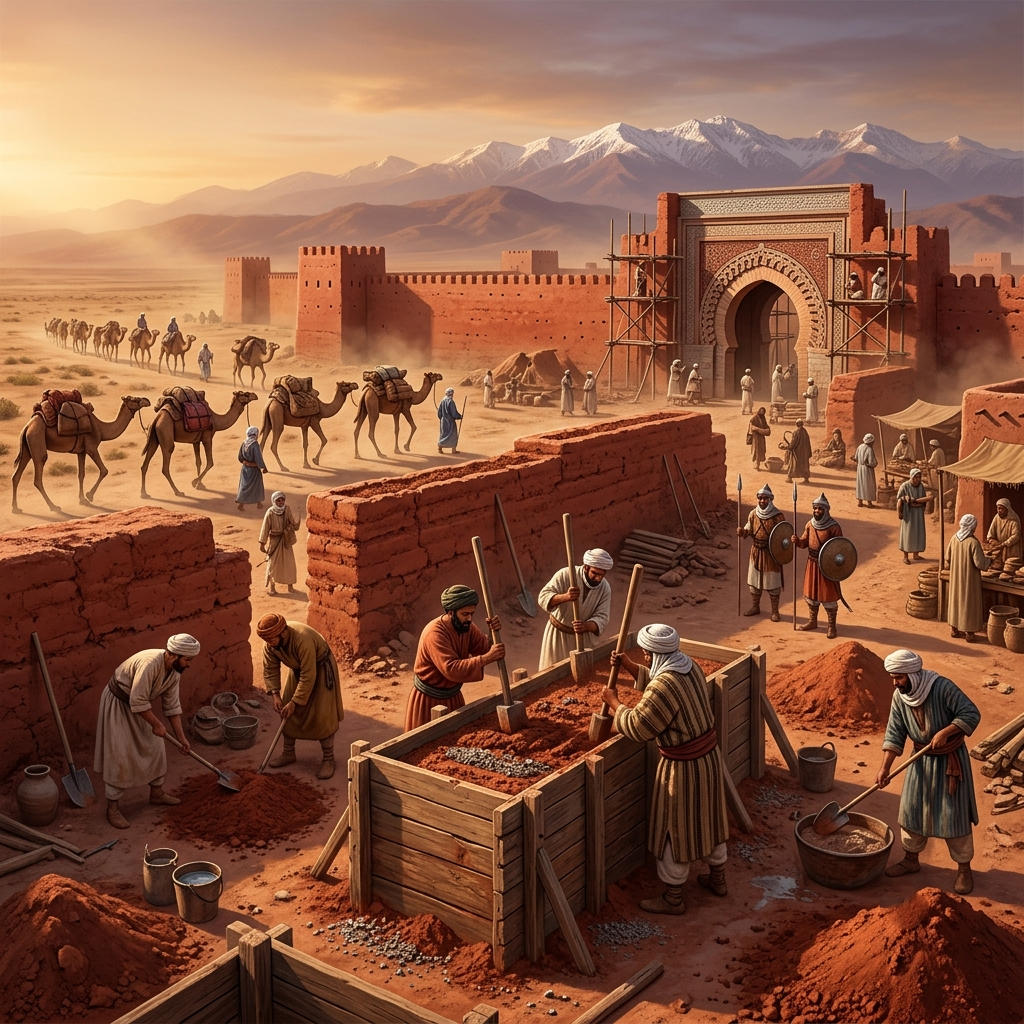
In 1070 AD, the desert chieftain Abu Bakr ibn Umar and his visionary cousin Yusuf ibn Tashfin laid the foundations of Marrakech, strategically positioning it as a military base and caravan hub at the foothills of the High Atlas. This key oasis controlled vital trans-Saharan trade routes, linking sub-Saharan gold and ivory trades with Mediterranean networks.
To secure their empire, the Almoravids engineered defensive clay fortifications using the ancient "Pisé" (rammed-earth) technique. By combining local red clay, river pebbles, lime, and gravel into wooden molds, they created walls that hardened under the hot sun.
This organic material gave Marrakech its iconic terracotta-rose hue and its title, "Al-Hamra" (The Red City). Over 19 kilometers of massive walls, punctuated by 200 watchtowers and majestic gates like the stone-carved Bab Agnaou, still wrap around the Medina, reflecting the raw defensive power of the desert warriors.
Golden Eras: Architectural Marvels of Marrakech
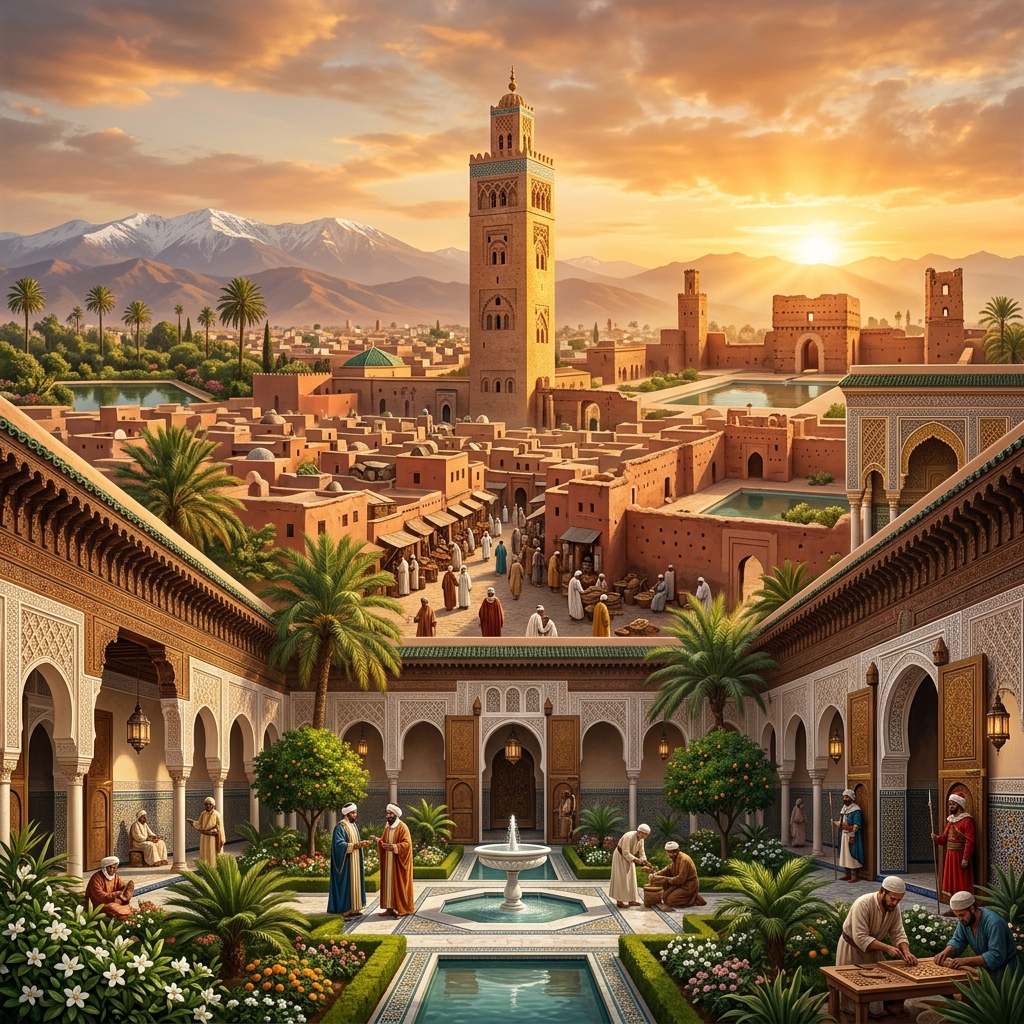
As the empire transitioned from the Almoravids to the Almohads in the 12th century, Marrakech witnessed an architectural revolution. The peak of this era was the construction of the majestic Koutoubia Mosque.
Its sandstone minaret towers 77 meters high, dominating the city skyline. Its geometric arches, proportions, and bands of turquoise ceramic tiles served as the direct template for both the Giralda tower in Seville and the Hassan Tower in Rabat, showcasing the height of Andalusian-Moroccan design.
This period also refined the domestic Riad. Designed as inward-facing homes with symmetrical central courtyards, Riads kept the hot Saharan winds out while creating a quiet private sanctuary. Symmetrical gardens, central stone fountains, and walls covered in intricate geometric Zelij tilework represented Islamic concepts of paradise, making each home a peaceful oasis.
The Living Heritage: Souks, Crafts, and Master Artisans
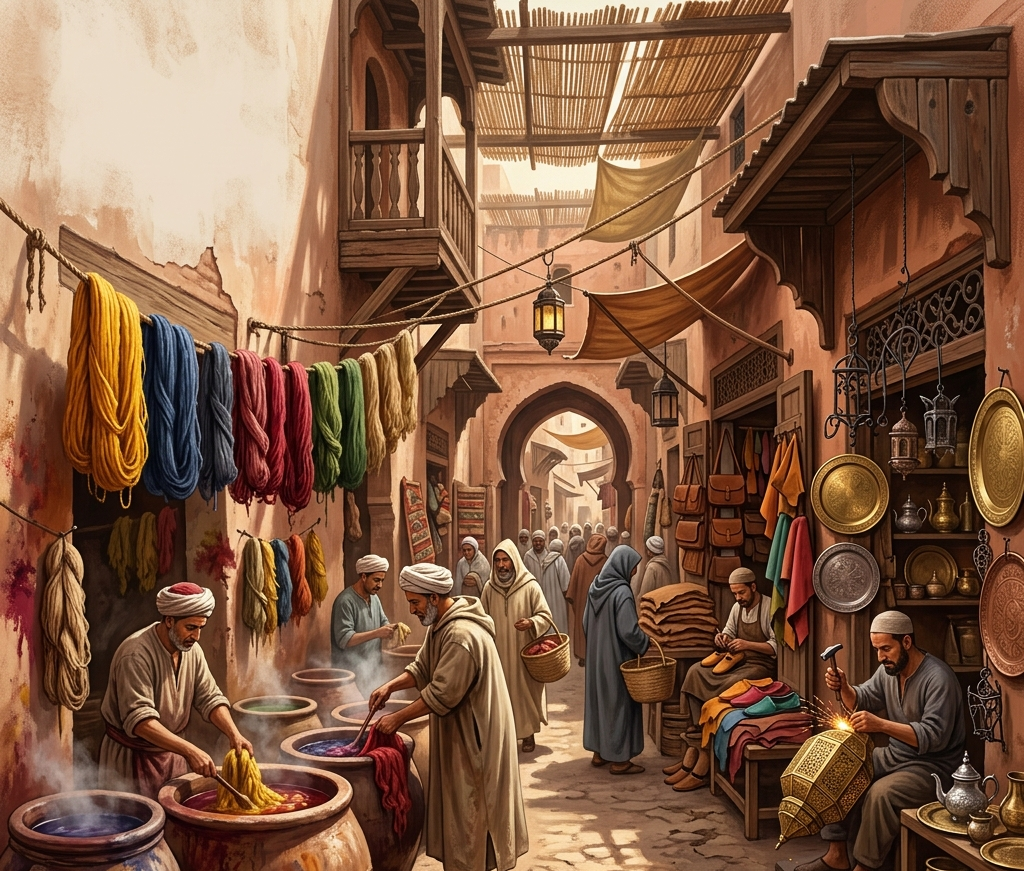
The historic heart of Marrakech is kept alive by its ancient craft guilds. Organized in specialized quarters across the Medina's labyrinth, these guilds preserve techniques passed down through generations under the guidance of a Maâlem (Master Artisan).
In the open-air yards of Souk el-Sebbaghine (Dyers' Souk), skeins of wool and silk are dipped into bubbling vats of saffron-yellow, indigo-blue, and poppy-red dyes. A few alleys away in Souk Haddadine, ironworkers hand-forge geometric brass lamps, while leather tanners use centuries-old organic mixtures to cure skins before crafting them into traditional slippers (Babouches) and cushions.
This creative buzz connects today's Marrakech to its historical roots, turning the ancient souks into a dynamic, living showcase of human heritage.